There are not many kaikomako trees in this forest, but there are 15 or more all around you here, in a big circle about 50 metres in diameter. I took these photos in early summer when they were covered in tiny white flowers. Some trees have male flowers, while others have female flowers that develop oily purple/black berries in autumn. These berries are the favorite food (kai) of bellbirds (komako). So stop, listen and look for bellbirds in the shorter months of the year. 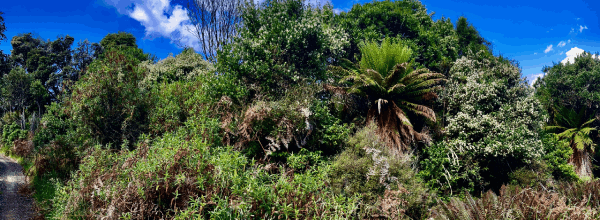 Looking
north-east
KIDS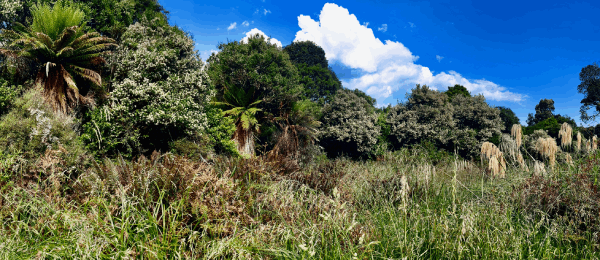 Looking south-east 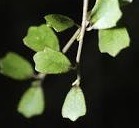 Baby kaikomako trees stopped moa birds from eating their leaves by growing in a "divaricating" way, with tiny ducks-feet leaves on tangled interlaced branchlets. As they got bigger, the kaikomako shape-shifted into a tree with 3 or four trunks and bigger leaves. This shape-shifting trick still protects the young kaikomako from being eaten by deer and goats. Alas, we haven't found a baby kaikomako to show you yet. But lots of different NZ species are divaricating. See how many different divaricating shrubs with different shaped leaves you can find as you walk along. If you find a divaricating shrub with leaves like ducks' feet - Eureka - you've found a baby kaikomako tree! Please take a photo with your cellphone and email it to us. Pic2map will tell us where you found it. TEENAGERS In old times, Maori made fire by rubbing a pointed hika of Kaikomako hardwood up and down a kaunoti fireboard of Mahoe softwood until a groove formed, with fine dust settling at one end. If it was then rubbed VERY vigorously, the dust would smoke and could be fanned into a flame that set fire to dry moss placed on it. Experiment (at home or at school) with different woods, shapes and ways of creating friction and find the fastest way to make fire this way. ADULTS Kaiokomako
is called Pennantia corumbosa. There are only 3 other Pennantia
species; on the East coast of Australia, on Norfolk Island, and
on Three Kings.
MAORI HERITAGE
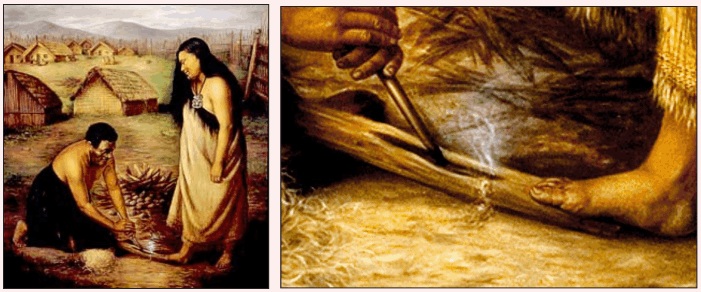 Ritual ceremonies were performed before almost every Maori activity. Many of these ceremonies involved tapu fires and steam ovens. Fire was looked upon as representing the sun, and so was seen to be a divine being, shut up in wood. Elsdon Best gives more details HERE |
|||