Paikea
is a mythic ancestor of the Ngati Porou tribe.
Various legends say he came from Hawaiki to
Whangara, just north of Gisborne, riding on the
back of a taniwha. Various
legends inspired Witi Ihimeara's 1987 novel, Whale
Rider, and the subsequent 2003 cinema film.
The
1870s haka
The
1930s action song
Uia
mai koia,1
whakahuatia ake;
Ko wai te whare nei e?
Ko Te Kani / Ko
Rangi / Whitireia!2
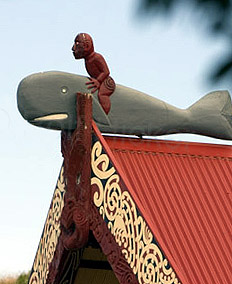
Ko wai te tekoteko kei runga?
Ko Paikea! Ko Paikea! 3
Ask
and you will be told;
What is the name of this house?
It is Te Kani /
It is Rangi / Whitireia!
Who is the carved figure above?
It is Paikea! It is Paikea!
Whakakau
Paikea. Hei!
Whakakau he tipua. Hei!
Whakakau he taniwha. Hei!
Ka ū Paikea ki Ahuahu. Pakia! 4
Paikea
swims to the surface. Hey!
A wizard emerges. Hey!
A deep-water prodigy is wading ashore. Hey!
Paikea lands at Ahuahu. Slap!
Kei
te whitia koe
ko Kahutia-te-rangi. Aue! 5
Me ai tō ure ki6
te tamahine 7
a Te Whironui - aue! 8
-
nāna i noho te Roto-o-tahe. 9
Your
identity is entwined
with Kahutia-te-rangi -yes!-
You were intimate with the daughter
of Te Whironui - really!-
who settled at the Lake-of-woman's-blood.
Aue!
Aue!
He koruru10
koe, koro e.
Alas!
Alas!
You are now a figurehead, old one.
Uia Mai Koia is
an old haka which tells of the origins of the
Ngati Porou people of of the North Island East
Coast. There is also a Te Arawa variant.
See below
Te Kani / Ko Rangi / Whitireia. Various
meeting houses are named in different versions of
this song.
Te Kani refers to a meeting
house (Photo)
built at Tolaga Bay in 1880 identified with Te
Kani-a-Takirau. Waho-te-rangi is a smaller, older
meeting house at Whangara, identified with
Kahutia's ancestor, Waha-o-te-rangi. Whitireia is a meeting house built at
Whangara in 1939. (Above) This name is used in
the Whale Rider version of the Paikea
song.
Paikea, Paikea's name in Hawaiki was
Kahutiaterangi; he received his name of Paikea
because he came to this land on the paikea, or
whale. Edward
Tregear, 1891
Ahuahu. Various islands throughout
Polynesia bear this name, in order to localise the
Kahutia-te-rangi /Paikea story in that region.
In NZ, Ahuahu is now called Great Mercury Island.
Kahutia-te-rangi, Polynesian Islander,
son of Uenuku, and survivor of shipwreck.
Ref. Mauke
Me ai tō ure ki. Literally You
coupled your penis to. A more delicate
phrase was used, Me awhi o ringa ki, You took
into your arms, when the old chant was
converted into an action song for fundraising
purposes in 1917.
Te tamahine a Te Whironu. The daugher
of Te Whironui. Her name was Huturangi.
Paikea took Huturangi as wife and she gave birth
to Pouheni.
And Pouheni => Tarawhakatu => Nanaia => Porou-rangi,
the founder of the Ngati Porou iwi.
See below
Te Whironui, the captain of the
Nukutere waka, which arrived in NZ seven
generations before the Mataatua waka.
Ref. Ngatirua
Roto-o-tahe.
This is sometimes written as Roto-o-tahi.
It is a small lake on the coast midway between
Whangara and Tolaga Bay. An old marae site, named
on the map as Rotootahi (Map),
is just inland from it.The lake is apparently
covered with blood-red water weed. (Aerial
photo).
Mikare
Pewhairangi, a Tokomaru Bay farmer, composed Paikea
as a haka in the 1870s.
He also composed other memorable haka; Kura
Tiwaka, Taramai Nuku and E Kui E Kui.
Tui Pewhairangi, who was a member of the Hikuwai men's
hockey club in the 1930s, says that they combined with
the Marotiri women's hockey team in the Cultural
competition at the Maori Hockey Tournament at Gisborne
to present Paikea as an action song, which they
performed on horseback! Their tune is still used
today, he said, but some people have altered the
words.(Tuini : her life and her songs, 1985)
During the First World War (1914 - 1918) the
words of the Paikea haka were made less direct
- ai tō ure was changed to awhi o ringa
- the actions were adapted to music in waltz time, and
it was performed as an action song, as above. (Ngāta
& Armstrong, 1960)
This tells of the origins of the Arawa people
further south, around Rotorua.
Uia mai koia, whakahuatia ake
Ko wai te waka
nei e? Te Arawa!
Ko wai te tohunga
o runga? Ko
Ngātoro-i-rangi!
Ko Ngātoro-i-rangi!
Whakakau Tainui,
hei!
Whakakau Mataatua
hei!
Whakakau Tokomaru
hei!
Ka ū Te Arawa
ki Maketu,
pakia!
Ko Tama-te-kapua
te tangata o runga
Me ai tō ure ki te ruahine
a Ngātoro-i-rangi
Nana i noho te kei
o te waka,
Aue! Aue! Ka raru
koe 'Toro
e.
Ask me and I shall declare
What is the name of the canoe?
It is Te Arawa!
Who is the high priest aboard her?
Ngātoro-i-rangi!
It's Ngātoro-i-rangi!
The canoe Tainui glides along, hei!
The Mataatua glides along, hei!
The Tokomaru glides along, hei!
And the Arawa lands at Maketu. Slap!
Tama-e-Kapua is her commander
and he is intimate with the wife
of Ngātoro-i-rangi
who sits in the stern of the boat,
Alas! Alas! You will be troubled, 'Toro.
Ngātoro-i-rangi
was the navigator of the waka Te Arawa.
Some say the the Arawa Uia mai koia was modified in
the 1870s to become the 'Paikea'
haka taparaha telling of the Ngati Porou people's
origins. Other sources say the Te Arawa version was
copied from the Ngati Porou version.
Polynesians
have had whales as voyaging companions for
thousands of years.
There were perhaps 200,000 whales in the
Pacific before European whalers arrived.
The oldest whale stories involve Tinirau,
(Tini Rau, Kinilau, Sinilau, Tinilau) the
god of the whales, who could appear as a
terrifying fish with its mouth wide open
and ready to devour its prey, or as a
handsome young man. Tinirau had a wife
called Hina who was a goddess of the Moon.
Pantheon.org
In later stories, Tinirau was a chief who
had a baby son, Tutunui. He threw the
child in the sea and it became a whale.
The wicked Kae asked Tinirau for a ride
back to his village on Tutunui, and when
he got there, he killed and ate Tutunui. Tongatapu.net.to
And today this has been sanitized as a
children's story. Tinirau is chief with a
pet whale which takes him on adventures to
other lands and safely home again.
Notice how these stories have been
transformed from great myths (expressing
the deepest fears, conflicts, and ideals
of the Polynesian people), to a soothing
story about a "real" person.
Is Kahutia-te-rangi/Paikea a real person? I
think he is a real person the way Kupe, or
Robin Hood, or Mary Magdalene are real
persons. Each of these is the composite of
several historical people, and their stories
help us face our fears and shape our ideals.
Note the ideas associated with Paikea: in
older Polynesian societies, Paikea is the
god of sea monsters, the son of Rangi and
Papa. Crabs are called paikea in the Cooks
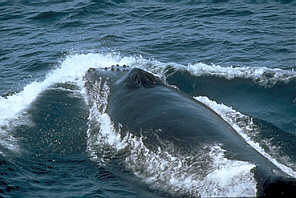
and pai'ea in Hawaii, and humpback whales
are called paikea in NZ Maori dictionaries.
In
older Polynesian societies, myths about
Paikea personify the awesome endurance of
creatures that challenged and survived the
stormy seas - crabs surviving hurricanes
in the tropics by clinging to drifting
logs, and humpback whales heading down
into the roaring forties every summer.
There are several different local
variations of the Kahutia-te-rangi story-
after a hurricane, he makes a raft out
of debris,
or he chants a karakia which enables him
to swim a long distance to shore,
or he rides in a waka named after a
whale,
or he becomes one with the spirit of the
whales,
or he rides on a whale,
or
he is a whale,
or
he is a taniwha.
And
in each variant of endurance at sea
Kahutia-te-rangi becomes known henceforth as
"Paikea" = "Mr Endurance." See
below
Many believe that Paikea is a real person
who truly rode on a whale from Eastern
Polynesia to the East Coast. We need to
understand the perspective from which this a
real person's true story.
We humans have two ways of thinking:
Literal -
"left-brain" - step-by-step logic, grasping
one little bit at a time, and
Symbolic -
"right-brain" - intuitively grasping whole
ideas all at once, by the association of
images and patterns.
Older societies used both literal and
symbolic thinking.
But in our Western society, the Greek/Roman
founders of our culture concenrtated
increasingly on literal, step-by-step,
cause-and-effect thinking. ( - using the
left side of the brain). This gave us Greek
logic, and Roman roads, and geometry, and
geography, and technology and ultimately
this internet communication. The downside of
all this is that we tend to pull stories
apart and judge each detail as a literal
fact.
We Westerners have largely lost the ability
to understand symbolic reality. This has led
to some strange reults:-
Early
Pakeha "scholars" distorted Maori
voyaging stories to produce a Great
Fleet as "factual history" Details
Creationists
have tried to prove that Bible stories
are objective accounts of historic
events.
Older
kids are unable to believe that Father
Christmas really brings them presents.
The
annual Father Christmas ritual
acknowledges and deepens parents' love
for their children, and that parental
love is real and true.
Symbolic reality involves the intuitive
association of ideas through images and
patterns. (The right side of the brain is
used for this.) Here-and-now truth is
conveyed by vivid analogies in the stories
we Westerners call myths. But we literal,
left-brain-using Westerners analyses mythic
stories as if they were distorted histories
of events long ago, far behind us, instead
of seeing them as analogies exploring our
own here-and-now fears, conflicts and
ideals.
However Polynesians of a millennium ago
still had well-exercised symbolic thinking.
They saw ancestors as being in front of
them, leading them. Life on their little
tropical islands was physically comfortable
- always warm, plentiful food, few enemies -
but boring. To live life to the full,
challenges were needed - what is beyond the
horizon? "Let's follow Maui and pull up
another island!" Achieving that
reality, I think, is what pushed them across
the Pacific.
In Tahiti they could voyage west back to
Rarotonga, and home again; voyage north to
Hawaii, and home again; and they would
eventually get east to South America, and
come home with kumara; ...
But south...???
There was obviously land to the south west,
because millions of birds were seen
migrating down there each spring and back
from there each autumn. But their waka ran
into bone-chilling prevailing sou'westerly
weather when they tried heading south. They
were confronted by stormy seas, they were
soaked by frigid waters, they were decimated
by hypothermia. How many never came home?
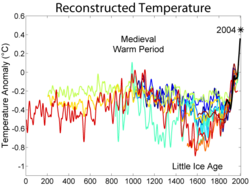
The Medieval Warm
Period
But about 1000 years ago there began a time
of global warming, the Medieval Warm Period.
And with warmer waters to sail in, some made
it to New Zealand, and back again. Over the
next couple of centuries others followed.
Then the climate cooled, the route was
blocked off again. And by then kumara had
been brought from South America (before 1250
AD). So how could you get the kumara down to
New Zealand? Impossible!
Unless you went with the humpback whales?
Every August, an estimated 120,000 of the
humpbacks started arriving at the warm
sheltered lagoons of the South Pacific so
the females could give birth.
... breaking the force of the
waves.
Every
October they headed south, slowly,
protecting their babies from orca killer
whales on a 5000 km journey to the Antarctic
feeding grounds. They traveled in pods, the
big old bull whales in front breaking the
force of the waves. They came down past the
east coast of the North Island of New
Zealand in November, using the shallow bays
as protection against killer whales.
If you got the breeding whales familiar with
your presence in the lagoon over a few
seasons, and if you built a waka the size of
a whale, and if you traveled south in the
middle of a migrating pod, then you would be
sheltered from those bone-chilling waves all
the way to the east coast of the North
Island of NZ.
Note:-
It would have been difficult to go back
north to Eastern Polynesia in convoy with
the whales. They fed all summer in the
Antarctic Ocean, straining huge mouthfuls of
krill from the rich waters there. (Two tons
per whale, per day, for three months). Then,
fattened with blubber, the 30-ton animals
would depart northwards again up the Tasman
sea.
They then sheltered in NZ coastal waters
from May onwards by cruising down past
Kapiti island, Cook Strait, the east coast
of the South Island, and to Foveaux Strait -
presumably those waters contained krill or
schools of small fish at that time of year.
Then in August the whales left via the
Chatham Islands for the tropical Polynesian
Islands again. Tony
F
Look at this oriori chant "Pōpō," a story
for children in pre-European-contact times
about bringing kumara from Hawaiki. It also
has details about beaching whales and about
Paikea.
Popo! E tangi ana Tama ki te kai
mana!
Waiho me tiki ake
ki te Pouahaokai,
Hei a mai te pakake ki uta ra
Hei waiu mo Tama!
Kia mauria mai e to tipuna,
e Uenuku!
Whakarongo!
Ko te kumara ko Parinuitera.
Ka hiki-mata te tapuae o Tangaroa,
.....Ka kia [e] Paikea Ruatapu i te
tama meamea,
Ka tahuri i Te Huripureiata,
Ka whakakau Tama
i a ia.
Hush, hush! The boy is crying for
food!
Let it (the
kumara) be fetched
from the Pou-aha-o-kai,
And the whale be driven ashore
To make mothers' milk for the boy!
Let it be brought by your ancestor,
by Uenuku!
Listen!
The kumara is
from Parinuitera.
The footsteps spell of Tangaroa is
begun.
When Ruatapu was called a bastard by
Paikea
He overturned Te Huri-pureiata,
AndPaikearecited a spell
to make himself a swimmer.
As
the Paikea waiata says:-
Whakakau
Paikea....
Whakakau he taniwha,
Ka u Paikea ki Ahuahu.
Kei te whitia koe
ko Kahutia-te-rangi.
Paikea emerges....
A sea-monster is coming ashore,
Paikea lands at Ahuahu.
Your identity is entwined with
Kahutia-te-rangi.
The personality of navigator
Kahutia-te-rangi became 'entwined with'
(whitia) the whales in which the spirit of
the taniwha Paikea dwelt, and so the spirit
of Paikea dwelt in Kahutia-te-rangi too. And
the kumara reached New Zealand.
But this attempt of mine to connect up historical
details is just minor left-brain stuff.
When you hear people from the East Coast of Aotearoa
proclaim...
"Ko Paikea te tipuna taniwha tangata."
...they
are proudly acknowledging, in vivid symbolic
format, that...
"...our Polynesian ancestors lived life to the
very edge, by venturing far across the deep and
distant waters,
...they succeeded in their ventures because they
strove to become at one with the great animals of
the deep ocean,
...and these ancestors are still there in front of
us, calling us to follow their example, until we
also achieve one-ness with other creatures."
As recorded from Moihi Te Matarohanga, Paikea did
not land at Ahuahu in New Zealand, but in Hawaiki
where Ahuahu was the site of Te Pakaroa, the Pa of
Ira and Ruawharo.
A man from Mauke (Northern Cook Islands) was out
fishing one day in his canoe when his wife Kea, up
on the cliff, saw a huge storm coming across the
sea. She shouted to her husband to come back to
land, but he didn't hear her. The storm caught him
at sea and blew him farther and fartheraway from the
island. Kea believed her husband was dead, and she
cried and cried on that cliff overlooking the sea
until she died of grief, and the people buried her
there.
He had not died at sea, however. He was blown very
far by the storm, but he finally did reach land -
the island of Mangaia. The people there did not want
him to stay and were on the point of killing him
when a woman who was half-Maukean took him under her
protection. With her help, he escaped from Mangaia
and sailed to Rarotonga where he finally left on the
waka Takitumu (Takitimu in NZ) when
it sailed to New Zealand. Lonely
Planet - Rarotonga
The Ngai Tahu writer Judy Voullaire says the man
blown out to sea from Mauke was named Kahutia Te
Rangi. He had swam around collecting tree trunks and
pandanus leaves, tied them together in a raft, then
let the current carry him south.
In the Cook Islands, says Voullaire, paikea are
the tiny crabs that survive hurricanes by clinging
to sea wrack, and Paikea is the name of the
Polynesian crab god, and other things that emerge
from the sea. When Kahutia Te Rangi was washed up
on Mangaia, he decided that from then on, he would
call himself Paikea. He escaped from Mangaia on a
waka named after a whale, the Areitereu.
William Colenso, (Transactions of the New
Zealand Institute 1881), wrote that Paikea was
the son of Uenuku and half-brother of Ruatapu.
However Ruatapu was the son of a slave and when
Uenuku insulted him about his low rank, he got
revenge by plotting to drown his brothers when at
sea in a canoe of their father.
Only Paikea survived the sinking of the canoe,
making land again at a place called Ahuahu (Great
Mercury Island of the coast of Northland, NZ), by
chanting a long spell which gave him strength
enough to swim the long distance.
Paikea took a wife at Ahuahu named Parawhenuamea
and they had several offspring; Marumuri and
others. Later, Paikea travelled to Whakatane where
he took as a wife Te Manawatina, and eventually to
Waiapu where he married a woman named Huturangi,
daughter of Whironui, the captain of the Nukutere
canoe ). Paikea and Huturangi had Pouheni
who then married Nanaia and bore Porou-rangi,
the ancestor who founded the Ngati Porou iwi.
(Waitangi
Tribunal Research Documents)
Note:- If we look all these accounts in a
left-brain way, as literal history, then Kahutuia
Te Rangi was tipped out of a canoe by his
half-brother at Whangara near Tahiti, swam to
nearby Ahuahu Island, migrated to Mauke in the
Cook Islands, married, was once again tipped out
of a canoe, by a storm, and rafted to Mangia.
Then instead of returning to his deeply devoted
wife Kea, he changed his name to Paikea and
migrated to Aotearoa in another canoe which tipped
him out yet a third time and he arrived here in
Aotearoa riding on a whale.
He landed here on another offshore island also
called Ahuahu, married a second time, then
travelled by whale to Whakatane, married again,
and finally travelled by whale again to another
place called Whangara where he married a fourth
time, to a sea-captain's daughter.
This geneology table is from S. Percy Smith's 1913
"translation" (?) of material "collected" (?) by H.
T. Whatahoro from the whare-wananga of Te
Matorohanga in the 1860s. Sacred
Texts/Pacific
Note:- Historian Kerry Howe has recently
given a warning, in his book about other New Zealand
historians, that both Percy Smith and Whatahoro
tended to "tidy up" Maori traditions.
Smith fancied himself as a scientist, an
ethnologist, and he attempted to extract historical
facts from mythic geneologies by re-arranging them
into "logical" order. (a left-brain man!)
And Whatahoro was adept at telling Smith what he
wanted to know, then getting payment and status for
it. He was also a member of Kotahitanga and
had his own motives for tidying up ancestoral
geneologies, so as to unify tribes.
K.
R. Howe,"The Quest for Origins: Who first
Discovered and Settled New Zealand...?"
Penguin, Auckland, (2003) page 162.
Te Kani-a-Takirau, 1790s - 1856, Ngati Porou
leader, lived at Uawa (Tolaga Bay). Several
descent lines of great importance to Ngati Porou
converged in him. Resembling the priest-kings of
central Polynesia, he was widely held in
reverence and was famous for his generosity.
Tradition has it that he was buried at Te
Ana-a-Paikea, the island offshore of Whangara
village.
Te Kani-a-Takirau never grew his own food, was
waited on and fed by a few people of high rank.
He refused to sign the treaty of Waitangi in
1840, although he was friendly towards European
traders. And he never became a Christian,
although he protected the mission that was
established at Uawa in 1843.
Later, when he was offered the Maori kingship he
declined, saying: "Hikurangi is the
mountain, Ngati Porou are the people and Te
Kani is the man." Mount Hikurangi had
never moved to dominate the centre of the
island, like the other mountains, but had stayed
with Ngati Porou, and so would he.
Full
details at DNZB.