|
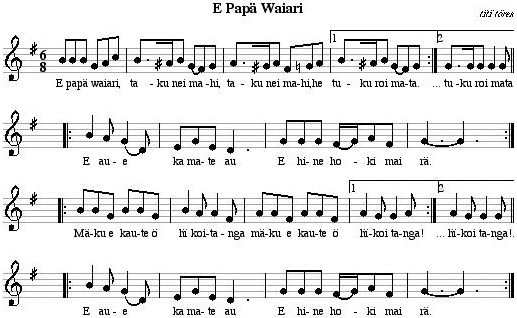
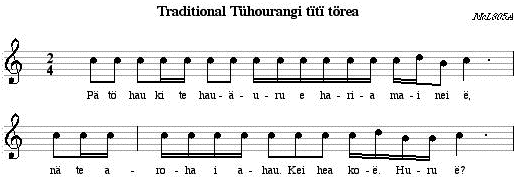
This t?t? t?rea is sung while playing t? rakau, the Maori stick game.In olden times, stick games trained young men in spear fighting, and traditional t?t? t?rea were chanted. In the USA it has sometimes been taught to Girl Scouts as "Lemmi sticks," confusing it with a traditional gambling game of the Lummi and other North-western tribes in which similar sticks are used.
Chords
|
|||||||||||||||||||||||||||||||||||||||||||||||||||||
|
Ma
|
koo
|
ay,
|
ko
|
tay
|
o,
|
ay
|
koo
|
ee
|
tah
|
nah
|
|
Ma
|
ku
|
e,
|
kau
|
te
|
o,
|
hi
|
ko
|
i
|
ta
|
nga
|
M?ku e, kaute ?, h?koitanga
Please note that this American pronuniation is incorrect.
This is closer to the correct Maori pronunciation.
|
Ma
|
ku
|
e,
|
kau
|
te
|
o,
|
hi
|
ko
|
i
|
ta
|
nga
|
|
Ma
|
koo
|
air,
|
kow
|
tair
|
or,
|
hi
|
koo
|
ee
|
tah
|
ngah
|
Here are nstructions for playing the game Ma koo ay .
Lemmi Sticks
|

In her excellent 1975 monograph, ethnomusicologist Wendy B. Stuart says gambling songs have an integral part of the Salishan tribal tradition since aboriginal times and have been maintained and preserved by oral means. Slahal, or the bone game, is of interest because of the ancient music which accompanies it.
 Click for full-size picture- Full details |
Slahal requires two pairs of cylindrical bone sections to be concealed in the hands. Each pair of bones consists of one marked and one unmarked bone. During the game, the bones are hidden in the hands while being mixed by two different individuals from one team, each manipulating one pair. The object of the game is that the opposite team guess the position of the unmarked bones.
Large amounts of money may be bet on the outcome of the game. There are 11 chopstick-sized twigs used as counters. And batons similar to those used in the Maori stick game are used by other team members to beat a rhythm on a long plank. In this 1946 photo, you can see one of the game bones in the open hand of one player. Click on it to see the original photo. You can also see women playing the stick game in 1925 by clicking here.
Wendy B. Stuart says that on the average, slahal songs have about 4 beats per second,which after some hours produce a trance-like state. In other words, the musical aspects of slahal lift it from the realm of an ordinary gambling game into something far more exciting.
There is an excellent brief explanation on how to teach children the guessing game of Slahal here. And instructions for teaching the rhythmic stick-beating chant are here.
A note to leaders of Girl Scouts in the USA
It is great to see that so many of you are teaching Maori stick games. But please do not teach your girls the mangled version of E Papa Waiari that is on some internet pages and tell them it is a Red Indian/Native American tune from the "Lemmi tribe." Here is the score of some real Lummi stick music.
Maori
Songs - Kiwi
Songs - Home
Tidied up May 2005. YouTube video added March 2008.
Revised for small screens Apr 2021.