Hoea Rä Te Waka Nei, 1917
A World War One sitting canoe
poi song, sung by an East Coast concert party who were
fund-raising for Maori soldiers fighting and dying in the
swamps of Passchendaele. The original song was quite
heart-breaking. After the war it was modified to become an
invitation to love-making. Today only a saccharine version
of the first verse is sung. |
||||||||||||||||||||||||||||||
| 1917 lyrics | literal translation |
| 1. Haeremai e hine mä, Me nga taonga o te wä, He reo karanga i katoa, Haeremai ki au. Chorus Hoea rä te waka nei. Hoea, hoea ki te pae Ma te poi e karawhiu E rähui i te pai. 2. Me pehea rä e taea ai Te aroha pehi kino nei, Mo te tau i pamamao Haeremai ki au! 3. Koia ra e hine mä Koha kore noa te pai. Haere me te atawhai Ka rahui i te pai. 4. Na te ngäkau tangi ra Ko te tiwaiwaka nei Te poi ka hoea atu nei He tohu no te pai. |
Come dear girls with the the gifts of the time (our action songs) calling to all, (who have come to this concert) "Welcome!" Paddle this canoe (support those in combat) Paddle, paddle to the horizon (to the war's end) May the beat of the poi (our fundraising concert) keep up the morale (of both us and our boys) What kind of evil is this that crushes my heart when my beloved is far away? Come to me! So it is, ye maidens suffering is not good at all. Come with generosity (Donate to the comfort fund) to aid the welfare. (of our boys overseas) How the heart cries out (a heartbreaking cry) "The fantail is here!" (telegram messenger of death) So the poi will be swung out (to raise money) as a sign of protection. (to help our boys survive) |
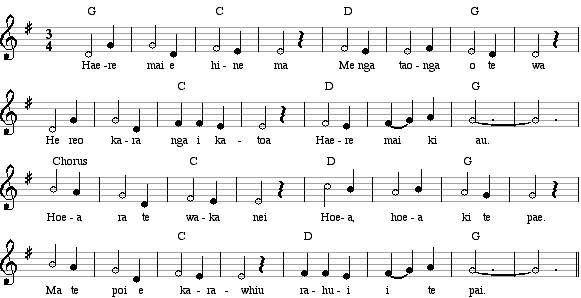 <="Tune">Original
1917 lyrics
<="Tune">Original
1917 lyrics|
|
|
|
Haere mai e hine mä Me ngä taonga o te wä He reo karanga i katoa Haere mai ki au Chorus Hoea rä te waka nei. Hoea, hoea ki te pai. 1 Mä te poi e karawhiu Kia rere tika ai. 2 |
Come all girls with the treasures of the time; This is a call to all of you, "Come here to me." Paddle this canoe there. Paddle, paddle for a good time. May the beat of the poi Make it slide the right way. |
Rhyming English, 1930s
Come oh maidens welcome here
You in all the world most dear
Sweetest voices draw you near
Come oh maidens, come
Gaily our canoe shall glide
Flowing o'er the rolling tide
Twirling pois shall lay beside
'Til we reach our home.
Footnotes:
1. The 1917 version was "Hoea, hoea ki te pae" - Sail, sail to the horizon, i.e. Fight on together until the war is won.
But this line is now sung as Hoea, hoea ki te pai - paddle, paddle for the good (time), i.e. Let's enjoy ourselves now that the war is over.
2. The 1917 line was "E rahui i te pai" - Protect the common good - ie. Do your duty. But this line is now sung as Kia rere tika ai - Make it glide along the right way.Sexual allusion Notice that in Maori culture, the pointed paddles wielded by the men and the slit-hulled canoe in which the women reclined were symbols of their respective sexual roles. So when the young soldiers came home from the war, this song was probably modified for use in love-games, with the man singing "Come on girls, bring your treasures here to me," and the girls provocatively responding with a request to "Paddle my canoe."
Origins of the Song
In July 1917 Paraire Tomoana took 55 men and women to perform at Waiomatatini (East Cape) at the marriage of Te Rina, daughter of Ngata, to Hetekia Te Kani Te Ua. There, and later at Manutuke and Gisborne, Paraire's group raised more than 250 Pounds.

This pre-1930 image was found in the Keystone-Mast Collection.
Does anyone recognise the location?In September, following an invitation by Apirana Ngata, Pariare Tomoana took Te Poi o Heretaunga, as the group was now called, to Wellington. Forty-five men and women performed in the Wellington Town Hall from 3 to 5 September, and later gave a performance at Trentham Military Camp.
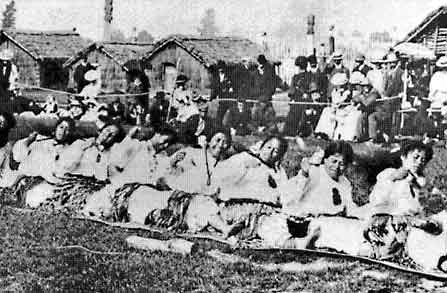
A canoe poi being performed in at the Christchurch Exhibition in 1907.
One of the songs they performed was written by Paraire, the later well-known Hoea ra te waka nei which was also known as Come where duty calls. The group raised £550 for the Maori Soldiers' Fund. At this time the 900 men of the Maori Pioneer Battalion were taking heavy losses digging combat trenches though the swamps of Passchendale and the Ypres Salient.
"Exhausted from days of paddling;" a canoe poi at Ruatoki in 1904.
Paraire announced that the group, billed as Te Ope Ngahau o Heretaunga (the dance group of Heretaunga), was to perform for 10 days at Christmas in Auckland.

Tomoana's 1919 Manuscript
Tomoana first published the 1917 lyrics of Hoea ra te waka nei in this 1919 fund-raising booklet, which the Alexander Turnbull Library kindly sent me a photocopy of. (It also has the words of Te Ope Tuatahi, and when this booklet was reprinted in 1921, Tomoana also included the lyrics of Pokarekare. in it.)
A NOBLE SACRIFICE" AND
"HOEA RA TE WAKA NEI"
("COME WHERE DUTY CALLS")Words and Action arranged by
Hon A. T. Ngata and P. H. TomoanaPROCEEDS IN AID OF MAORI SOLDIERS'
FUND
Hoea ra te Waka Nei
(COME WHERE DUTY CALLS )
(Poi song imitating in action the crew of a war canoe)
Maori 1.
Haeremai e hine ma,
Me nga taonga o te wa,
He reo karanga i katoa,
Haeremai ki au.
Chorus 2.
Hoea ra te waka nei.
Hoea, hoea ki te pai.
Ma te poi e karawhiu
E rahui i te pai.
Me pehea ra e taea ai
Te aroha pehi kino nei,
Mo te tau i pamamao
Haeremai ki au
3.
Koia ra e hine ma
Koha kore noa te pai.
Haere me te atawhai
Ka rahui i te pai.
4.
Na te ngakau tangi ra
Ko te tiwaiwaka nei
Te poi ka hoea atu nei
He tohu no te pai.English
Come ye maidens, come to me
Singing songs of melody
Crying near and far to all
"Come where duty calls."
Then together we will draw
This canoe until the end,
To the goal the world desires
Peace and joy for all.
Would you still the aching heart
Ease the pain that gnaws within
For the dear ones far away
Gone where duty calls
Cleansed by war of all its dross
Love is gleaming strong and bright.
In our hearts we vow to serve
Where our duty calls
Small may be this our canoe
Floating in a sea of tears
Tribute to the brave who fell
Where their duty called.
The English version is a free rendering of the Maori, and must not be taken as a correct translation. It seeks to convey to an English audience the motive of the poi-dancers in making their appeal to the patriotism of the public.
1926 Piano ScoreYou will find several spelling errors in the Maori lyrics printed on this 1926 piano score, and capital letters have been used at random. But its English verses are closer to the Maori in meaning. Used in a 1950s medleyIn more recent times, the first verse of Hoia Ra has be used in performances dramatising the coming of the Maori from Hawaiki (Eastern Polynesia, near Tahiti) to New Zealand.
Yeah, right! A reality check.Some of the above statements should not be taken at face value."...For weeks on end, the primitive canoes sailed the vast empty ocean, without charts, without navigating instruments..."Primitive canoes? Spend some time exploring the web-site of the Polynesian Voyaging Society. Other Maori songs of World War OneTipirere: 1914 - Its a long way to Tipperary... A Mother As Lovely As You
However
when Tomoana's children heard the tune being used
in Smith's song back in the 1950s, they made no
claim for royalties. This could indicate they knew
Pariare Tomoana had indeed used an old folk tune
to put his Hoea Ra words to.
Worldwide popularity
Page published on web Feb 25th 2003, updated Jan 2022. |